Translation in your mothers language

Friday, March 11, 2011

Tsunami hits north-eastern Japan after massive quake


Tsunami hits north-eastern Japan after massive quake


source : BBC

Tsunami hits north-eastern Japan after massive quake


A massive earthquake has hit the north-east of Japan, triggering a tsunami that has caused extensive damage.

Japanese television showed cars, ships and even buildings being swept away by a vast wall of water after the 8.9-magnitude earthquake.

The quake has sparked fires in several areas including Tokyo, and numerous casualties are feared.

It struck about 250 miles (400km) from the capital at a depth of 20 miles. There have been powerful aftershocks.

The tremor hit at 1446 local time (0546 GMT). Seismologists say it is one of the largest earthquakes to hit Japan for many years.

At the scene

When the earthquake hit, buildings in Tokyo swayed. Walking was like crossing the deck of a ship at sea.

People poured down from their offices and stood in the street staring up.

A large fire seemed to have broken out in one part of the city and, in another place, injured people were being brought out of a station.

The authorities immediately issued a tsunami warning.

In Tokyo, public transport has been suspended, elevators are switched off in many buildings and thousands of people have gathered in squares and around train stations.

xxxxxxxxxxxxxxxxxxxxxxxxxxxxxxxxxxxxxxxxxxxxxxxxxxxx

The tsunami warning was extended to the Philippines, Indonesia, Taiwan, the Pacific coast of Russia and Hawaii.

The Pacific Tsunami Warning Center said the wave could extend as far as Chile.

Tsunami waves hit Japan's Miyagi and Fukushima prefectures, officials said, damaging dozens of coastal communities.

Japan's NHK television showed a massive surge of debris-filled water sweeping away buildings, cars and ships and reaching far inland.

Motorists could be seen trying to speed away from the wall of water.

Farmland around the coastal city of Sendai was submerged and the waves pushed cars across the runway of the city's airport.

'Seasick'

The earthquake also triggered a number of fires, including one at an oil refinery in Ichihara city in Chiba prefecture near Tokyo, engulfing storage tanks.

There were reports of about 20 people injured in Tokyo after the roof of a hall collapsed on to a graduation ceremony.

Residents and workers in Tokyo rushed out of apartment buildings and office blocks and gathered in parks and open spaces as aftershocks continued to hit.

Many people in Tokyo said they had never felt such a powerful earthquake.

Map of Japan

In central Tokyo, Jeffrey Balanag said he was stuck in his office in the Shiodome Sumitomo building because the elevators had stopped working.

"There's no panic but we're almost seasick from the constant rolling of the building," he told the BBC.

Bullet train services to northern Japan were halted, rapid transit in Tokyo was suspended and some nuclear power plants automatically shut down.

Prime Minister Naoto Kan said there had been no radiation leaks.

In a televised address, he extended his sympathy to the victims of the disaster and said an emergency response headquarters had been set up.

He said the earthquake had a magnitude of 8.4 while the US Geological Survey said it measured 8.9.

xxxxxxxxxxxxxxxxxxxxxxxxxxxxxxxxxxxx

Massive quake hits Japan; triggers Tsunami


At 2.46 pm Japan time, an earthquake measuring 8.9 on the Richter scale struck in mid-ocean at a depth of 24.4 km, 130 km (80 miles) from the coastal city of Honshu and 373 km (231 miles) from Tokyo.

The quake, which was followed 30 minutes later by an aftershock registering above 7, triggered 13 meter high waves that struck the coast off Honshu, washing away cars and people and destroying buildings.

All power is down in the affected region, and all trains and buses have been stopped in Tokyo. Narita International airport has also been shut down for inspection of runways and other facilities. The country's nuclear plants have all been shut down as a safety measure.

We bring you updated information as received; refresh for the latest:

3:12 pm:
Little things make a big difference. The Japanese government, currently battling the worst earthquake to hit the quake-prone country in 140 years, found the time and sensitivity to do the little things: reports say that with cellphone services out of whack, the government has made all pay phones free of charge to enable people to stay connected at a time of considerable chaos.

3:07 pm:
Residents in the Phillippines have been warned to evacuate and move to high ground, with weather experts predicting the first waves of the tsunami to strike around 6 PM local time. The Coast Guard has been put on high alert, and rescue teams have been placed in a state of emergency alert.

3:05 pm:
Authorities in Taiwan have warned that tidal waves triggered by the Japan quake could reach the eastern coast of the Island at around 5.30 PM local time, and also possibly hit the north-eastern port of Keelung by 6:00 pm.

3:03 pm:
The US Geological Society meanwhile has reported a secondary quake, timed at 5.12 PM Japan time, of magnitude 6.2, also near the eastern coast of Honshu. More

3:00 pm:
In another illustration of how social media is supplementing, even exceeding, the work of news agencies, the CitizenTube initiative features videos of the Japan quake shot by the people themselves. Watch video

2:41 pm: Within half an hour of the quake, the Twitter monitoring service Tweet-O-Meter indicated that tweets out of Tokyo were streaming in at the rate of over 1,200 per minute.

2:40 pm:
Tsunami alert issued across US West Coast; evacuation on in Hawaii.

Photos: Tsunami damages northern Japan

2:30 pm: 11,000 evacuated in Russia in the wake of Japanese tsunami

2:29 pm:
With a massive electricity and communications blackout impacting the quake-hit area, estimates of the toll and damages will take a considerable time to be collated. For now, the Japanese government is officially reporting five dead, AP reports.

2:27 pm:
Though the Sensex fell over 200 points in reaction to the news of the quake, no lasting impact on the economy is expected, say experts. More

2:24 pm:
The United States Geological Survey, which has been tracking the quake and its aftermath, has pegged the Japan quake at 8.9 on the Richter scale. That makes this the 5th biggest earthquake in history, ahead of the February 2010 quake in Chile. See chart

2:22 pm:
Four million homes in Japan have no power supply.

2:21 pm:
Sendai airport in northern Japan flooded.

2:17 pm:
Japanese news agency Kyodo reports that as many as 14 public structures are on fire in Tokyo.

2:15 pm:
The Japan Meteorological Agency in a press statement warned that aftershocks of a possible magnitude of 7 and above on the Richter scale could happen in a month, consequent on today's quake.

2:15 pm:
AP reports that Russian authorities have evacuated over 12,000 residents of the far-eastern Sakhalin Island and its neighborhood as a consequence of the tsunami warning.

2:05 pm:
Biggest quake since 1995, say Japanese met officials.

2 pm:
Blaze continues at major oil refinery. Fires break out in Tokyo as well. Aftershocks continue in Tokyo. Casualty numbers trickling in.

1:55 pm: Kudan Kaikan auditorium collapses: 600 had gathered for a graduation ceremony, 30 seriously injured.

1:53 pm: Television studio cameras shake as aftershocks continue.

1:52 pm: Tsunami warnings for Australia, New Zealand.

1:45 pm: Japan's disaster management team is headed by its prime minister Naoto Kan. One of the biggest earthquakes ever to hit the country, says met office.

Tsunami may hit Indonesia, Hawaii next.

1:26 pm: Japan has swung into disaster control mode following a tsunami and massive earthquake on Friday.
The country has shut down all its ports, airports and nuclear installations.

World television channels showed cars and boats being swept onshore by huge tidal waves. A bigger tsunami is feared.

Ravi Shingari, director, KPMG, Japan, told CNN-IBN over the phone that the Japanese were not as shocked by the tremors as the Indians.

The nearest city to the epicenter is the coastal city of Honshu, 130 km (80 miles) from the quake center. Tokyo is 373 km (231 miles) away.

The quake was approximately 24.4 KM deep within the ocean. Al Jazeera is running a live stream of the disaster:

Japanese prime minister Naoto Kan said no radiation leak had been reported from any nuclear installation.

The authorities had no casualty numbers, and said they were concentrating on 'relief and rescue'.

Thousands of passengers are trapped in trains, which have stopped mid-way. Prime minister Kan said they would be rescued, and appealed to people in all parts of Japan to be vigilant.

Prime minister Kan is addressing the nation. 'Stay calm', is his message.

The tidal waves were 13 feet high, met reports say.

Buildings in Tokyo shook and made creaking sounds, according to an Indian executive working in that city.

An oil refinery is on fire, and the fire authorities are fighting a losing battle.
People are milling around Tokyo station as all trains and buses have been halted.
Stranded passengers can't find any taxis either.

1 pm (India time): All airports have been closed in Japan as the authorities fear fires will break out following the tsunami.

Japanese public broadcaster NHK showed cars, trucks, houses and buildings being swept away by the tsunami.

Earthquakes are common in Japan, one of the world's most seismically active areas. The country accounts for about 20 percent of the world's earthquakes of magnitude 6 or greater.

Reuters reports: A massive 8.8 magnitude quake hit the northeast coast of Japan on Friday, shaking buildings in the capital Tokyo, causing "many injuries", at least one fire and triggering a four-metre (13-ft) tsunami, NHK television and witnesses reported.

There was also a warning of a 10-metre tsunami following the quake, Japan's biggest in 7 years.

The public broadcaster showed flames and black smoke billowing from a building in Odaiba, a Tokyo suburb, and bullet trains to the north of the country were halted.

Black smoke was also pouring out of an industrial area in Yokohama's Isogo area.

TV footage showed boats, cars and trucks floating in water after a small tsunami hit the town of Kamaichi in northern Japan.

"The building shook for what seemed a long time and many people in the newsroom grabbed their helmets and some got under their desks," Reuters correspondent Linda Sieg said.

"It was probably the worst I have felt since I came to Japan more than 20 years ago."

Passengers on a subway line in Tokyo screamed and grabbed other passengers' hands. The shaking was so bad it was hard to stand, said Reuters reporter Mariko Katsumura.

The U.S. Geological Survey earlier verified a magnitude of 7.9 at a depth of 15.1 miles and located the quake 81 miles east of Sendai, Honshu. It later upgraded it to 8.8.

The Tokyo stock market extended its losses after the quake was announced. The central bank said it would do everything to ensure financial stability.

Japan's northeast Pacific coast, called Sanriku, has suffered from quakes and tsunamis in the past and a 7.2 quake struck on Wednesday. In 1933, a magnitude 8.1 quake in the area killed more than 3,000 people. Last year fishing facilities were damaged after by a tsunami caused by a strong tremor in Chile.

Earthquakes are common in Japan, one of the world's most seismically active areas. The country accounts for about 20 percent of the world's earthquakes of magnitude 6 or greater.

source : Yahoo


Location Date UTC Magnitude Lat. Long. Reference
1. Chile 1960 05 22 9.5 -38.29 -73.05 Kanamori, 1977
2. Prince William Sound, Alaska 1964 03 28 9.2 61.02 -147.65 Kanamori, 1977
3. Off the West Coast of Northern Sumatra 2004 12 26 9.1 3.30 95.78 Park et al., 2005
4. Kamchatka 1952 11 04 9.0 52.76 160.06 Kanamori, 1977
5. Offshore Maule, Chile 2010 02 27 8.8 -35.846 -72.719 PDE
6. Off the Coast of Ecuador 1906 01 31 8.8 1.0 -81.5 Kanamori, 1977
7. Rat Islands, Alaska 1965 02 04 8.7 51.21 178.50 Kanamori, 1977
8. Northern Sumatra, Indonesia 2005 03 28 8.6 2.08 97.01 PDE
9. Assam - Tibet 1950 08 15 8.6 28.5 96.5 Kanamori, 1977
10. Andreanof Islands, Alaska 1957 03 09 8.6 51.56 -175.39 Johnson et al., 1994
11. Southern Sumatra, Indonesia 2007 09 12 8.5 -4.438 101.367 PDE
12. Banda Sea, Indonesia 1938 02 01 8.5 -5.05 131.62 Okal and Reymond, 2003
13. Kamchatka 1923 02 03 8.5 54.0 161.0 Kanamori, 1988
14. Chile-Argentina Border 1922 11 11 8.5 -28.55 -70.50 Kanamori, 1977
15. Kuril Islands 1963 10 13 8.5 44.9 149.6 Kanamori, 1977
Updated 2010 March 29
Source : USGS

In Japan, Prime Minister Naoto Kan addressed the nation, saying the government will do "everything possible to minimize the damage" and calling for international assistance. "We ask the people of Japan to exercise the spirit of fraternity and act fast and to assist one's family and neighbors," Kan said.

Several countries, including Russia and South Korea, pledged support, putting emergency crews on standby. The U.S. military - which said all its personnel in Japan were accounted for - announced it was coordinating with Japan's government.

President Obama, who was briefed on the quake about 4 a.m., said the United States "stands ready to help the Japanese people in this time of great trial."

Authorities ordered evacuations from low-lying areas on the U.S. island territory of Guam in the western Pacific, but the tsunami passed that area without causing significant damage, according to news reports.

In Japan, the quake struck at 2:46 p.m. local time (12:46 a.m. in Washington). According to the U.S. Geological Survey, the quake struck at a depth of about six miles, about 80 miles off the coast east of Miyagi Prefecture, a mostly rural but still densely populated part of Honshu, Japan's largest island.


Monday, March 7, 2011

Comment: Allow a dignified death or not

By R Shankar, India Syndicate, 07/03/2011

Comment: Allow a dignified death

Source : MSN

India has finally said a big no to mercy killing. The Supreme Court verdict on Monday in the Aruna Shanbaug case has finally laid to rest the debate on whether a patient lying in a "persistent vegetative state" can get a dignified death.

Comment: Allow a dignified death

The ruling came in the case of Aruna who has been lying in a painful and vegetative state in Mumbai's KEM Hospital for over 37 years after a brutal sexual assault.

Those who favoured mercy killing had pleaded before the court that feeding of the nurse should be stopped immediately so that she can have a dignified ending.

Aruna, a nurse from Haldipur, Shimoga, Karnataka, was brutally assaulted by Sohanlal Bhartha Walmiki, a ward boy at Mumbai's King Edward Memorial Hospital on Nov 27, 1973, as she was changing her clothes in the basement of the hospital. As she was having her periods, Walmiki sodomised her after choking her with a dog chain.

The asphyxiation caused due to the dog chain round Aruna's neck cut off oxygen supply to her brain resulting in `death' of a critical part of the brain stem and cervical cord injury leaving the nurse cortically blind and had reduced her to a vegetative stage.

Comment: Allow a dignified death

Walmiki attacked Aruna as she had ordered him about and had castigated him for sloppy work. The ward boy is now a man in his fifties, free man and is reportedly working in Delhi.

The apex court ruling came in a case filed by activist Pinki Virani who contended that Aruna cannot see or speak properly and keeping her alive violates her right to live with dignity.

As the case took various emotional twists and turns, the apex court appointed senior doctors to examine Aruna and present their views on euthanasia. Dr JV Divatia, Dr Roop Gurshani and Dr Nilesh Shah subsequently examined Aruna and submitted a report in which they said that the nurse responds to devotional music, gets upset when people crowd around her and is fond of certain food items. Hence, the panel said, Aruna may not be completely vegetative.

Though the Supreme Court has rejected Aruna's death wish, it is also not fair to keep terminally ill patients in excruciating pain and agony. The court should lay guidelines under which mercy killing should be an option in the following two circumstances:

1-Patient cannot decide: Mercy killing should be allowed in very special and extra-ordinary cases where hope of living is dead and the pain and agony are unbearable. If a panel of reputed senior doctors unanimously agree that there is absolutely no hope of a recovery, and if the patient cannot independently decide on the death wish, the patient should be allowed to die.

2-Patient can decide: If a patient who wants to die as he or she is suffering from a terminal ailment and doctors agree that there is no hope of recovery, doctors should be legally allowed to put the patient to permanent sleep.

Comment: Allow a dignified death

WHAT IS EUTHANASIA?

The official medical definition of euthanasia is: Deliberate and intentional killing of a human being by a direct action, such as a lethal injection, or by the failure to perform even the most basic medical care such as the provision of nutrition and hydration, necessary to maintain life.

Euthanasia is also called:

Voluntary Euthanasia: Mentally competent patients who want to end thier lives in order to relieve either physical or emotional distress which they declare unacceptable.

Medically Assisted Suicide: Patients are provided with the means and assistance to commit suicide.

Involuntary Euthanasia: Patients who are not in a position to give consent for a peaceful ending because of immaturity such as a newborn infants, mental disability, mental or physical illness or coma. In these instances, it is decided by others -- relatives or ativists -- that the person should be killed.

Euthanasia has, however been rejected by many countries. In 1996, the Australian House of Representatives quashed the Northern Territory Euthanasia Legislation that favoured mercy killing. Other nations who have strongly recommended against legalising euthanasia are: Canada 1982, Victoria 1987, Great Britain 1994, New York State 1994.

WHERE IS EUTHANASIA LEGAL

Euthanasia is legal in The Netherlands, Switzerland, Belgium, Norway, Sweden, Germany, Finland, Luxembourg, Albania and Thailand. A few States in the US too have what is called 'Death with Dignity Act'.

Comment: Allow a dignified death

DIGNIFIED END: Doctors of death or angels of mercy?

There are cases where doctors have `helped' terminally ill patients to meet a dignified end. Here are a few `doctors of dignified death':

Jack Kevorkian

Kevorkian, was infamously or famously (depending on which side of euthanasia you are) called `Dr Death'. An Armenian-American pathologist, he started off by photographing the eyes of dying patients. Seeing their agony, pain and suffering, he started offering 'death counselling'. He issued advertisements too. He is reported to have helped over 130 people to `have a peaceful and permanent death.' Though he has been hitting the headlines off and on, he was intensely debated when he made a film on Thomas Youk, a terminally ill patient who was put to death. The film was shown on the popular American TV series called '60 Minutes'.

John Bodkin Adams

Adams was an Irish-British general practitioner who allegedly 'killed' 160 patients between 1946 and 1956. He was put on trial and found guilty in 13 cases classified as prescription fraud, lying on cremation forms, obstructing a police search and failing to keep a dangerous drug registered. But a turn-around came in 1957 when Judge Devlin ruled that "causing death through the administration of lethal drugs to a patient, if the intention is solely to alleviate pain, is not considered murder even if death is a potential or even likely outcome".

Dignitas

Switzerland-based Dignitas is probably the only 'recognised assisted dying group' that helps patients with terminal illness and severe physical and mental illnesses to die peacefully. The patients are assisted by qualified doctors and nurses. The group also renders help for assisted suicide if those seeking help are of sound judgement. These suicide seekers should obtain a detailed medical report from a qualified and recognised psychiatrist that endorses the patient's condition as fulfilling the specifications of the Federal Court of Switzerland.

Source: India Syndicate

Aruna Shanbaug will live, says Supreme Court

New Delhi: The Supreme Court Monday rejected a petition for the mercy killing of Aruna Shanbaug, who has been in a "persistent vegitative state" for the past 37 years after being sodomised by a hospital sweeper but permitted passive euthanasia subject to a declaration by a high court to this effect.

Aruna Shanbaug will live, says Supreme Court

An apex court bench of Justice Markandey Katju and Justice Gyan Sudha Misra delivered the ruling while rejecting a petition moved on Shanbaug's behalf by her friend and social activist Pinki Virani.

Justice Katju said that active euthanasia is illegal as there is no statutory provision to support it.

However, the court said: "Passive euthanasia is permissible under certain conditions with the approval of the high court."

It further said the high court will grant its approval after getting the opinion of three eminent doctors and hearing the government and the close relatives of the terminally ill patient sought to be put under passive euthanasia.

The court said though Virani is performing a laudable social service, the staff, doctors and nurses of Mumbai's King Edward Memorial Hospital, where Shanbaug is admitted have a greater right over her and only they can decide whether to opt for passive euthanasia or not.

"She (Virani) cannot claim to be as close and attached to Aruna Shanbaug as King Edward Memorial Hospital staff and nurses," the bench ruled.

Active euthanasia is a state where a patient is given a lethal injection to bring him to sleep, while passive euthanasia involves withdrawing the life support system from a patient.

Source: IANS


http://news.in.msn.com/national/article.aspx?cp-documentid=5002196

Friday, March 4, 2011

Court quotes a poem, lets `Q' walk free

05/03/2011

Court quotes a poem, lets `Q' walk free

New Delhi: Twenty five years gone, Rs. 250 crore spent, two extradition cases lost in international arena, no “legally sustainable” evidence in hand. Underlining these, a Delhi court on Friday exonerated Italian businessman Ottavio Quattrocchi from penal charges in the 1986 Bofors payoff case and approved a CBI application seeking withdrawal of his prosecution.

CBI closes 'Q' case

Reached for comments in Italy, Quattrocchi told The Indian Express: "I am relaxing. God bless."

While delivering the verdict, Chief Metropolitan Magistrate Vinod Yadav recited Sahir Ludhianvi: "Woh afsana jise anjaam tak lana na ho mumkin, use ek khoobsurat more dekar chhorna hi achha (It's better to end a story on a good note in case it cannot be brought to a logical end)."

"The very question which stares us at our faces is whether it is justified for the Government of India to continue to spend on the extradition of Q, which may or may not ultimately happen during his lifetime. Can we allow this hard earned money of aam aadmi of India to be spent on these type of proceedings, which are not going to do any good to them, after almost 25 years of the so-called arms deal. The answer would be a big No," CMM Yadav said in his 73-page judgment.

Adjudicating the CBI's plea on the triple test of good faith, bonafide and public interest, he said it was clear in the last 21 years when the prosecution against Quattrocchi was on that "despite spending through its nose for about these years, the CBI has not been able to put forward legally sustainable evidence with regard to conspiracy in the (Bofors payoff) matter."

Delhi court accepts CBI plea to close case against Quattrocchi

While the allegation pertained to a kickback amounting to Rs. 64 crore, the CBI, by 2005, had already spent around Rs. 250 crore on the case "which is sheer wastage of public money," Yadav said.

The court accepted the contention of Additional Solicitor General P P Malhotra regarding the two failed attempts to get Quattrocchi extradited that these would act as an adverse precedent for any more attempts by the Government of India.

The CMM noted that while the El Dorado court in Argentina had described the extradition proceedings as for "political reasons," the court in Malaysia had discussed, besides legalities, the merits of the case while dismissing the CBI's petitions.

Delhi court accepts CBI plea to close case against Quattrocchi

"A joint reading of the judgments of both the countries would reveal that on facts of case, both countries expressed that offence of conspiracy and cheating was not made out against Q, as the terms of the agreement between the Government of India and M/s AB Bofors did not prohibit induction of foreign agents in the contract and in any case, if there was violation of any term of contract, that only leads to civil consequences and not penal consequences," the CMM said, adding that extradition requests were not entertained on sound reasoning.

Referring to a Delhi High Court judgment that had ordered quashing of a related FIR in the case, the court noted that all other accused persons, besides Quattrocchi, had either died or the proceedings against them, including those against M/s AB Bofors, had been quashed.

"Therefore, the decision of the learned Special Prosecutor of CBI, seeking withdrawal of prosecution against Q on the face of it appears to be bonafide and in the larger public interest. Accordingly, the learned Special Prosecutor of CBI is allowed to withdraw prosecution against Q. Consequently, Q stands discharged from this case," CMM Yadav ruled.

Source: The Indian Express

Also see

Bofors payoffs: Twists and turns in case against Quattrocchi


Secret report on fake notes blames Pak


05/03/2011


Secret report on fake notes blames Pak

New Delhi: A secret Government report, that claims to be based on a “million intelligence inputs,” has named officials in the Pakistan High Commissions in Dhaka and Kathmandu as being responsible for not only manufacturing but also distributing Fake Indian Currency Notes (FICN).

For the first time, the Government has put a figure to the value of FICN in "circulation" -- Rs. 16,000 crore, and linked it to at least 15 cases of terrorist funding.

The 65-page report, obtained by The Indian Express, categorically blames Pakistan for running what it calls a "sophisticated buisness enterprise covering many countries."

It lists 28 important "FICN network operator gangs" out of Bangkok, Bangladesh, Nepal and Pakistan which are "so well established that they could also be used for arranging hide-outs, for easy and secure communication channels to subversives and safe launch-pads for espionage agents."

The report says that 36.8% of large FICN seizures (above Rs. 10 lakh) over a five-year period have been "directly" sourced from Pakistan and the remaining "indirectly" -- with consignments first sent to a "staging-post" country and seized while on their second or third-leg journeys into India.

The report contains a list of 11 officials purportedly of the Pakistan Government either associated with the ISI or the High Commission.

"Regular intelligence feeds are available with numerous references to the FICN trade in Bangladesh and Nepal where menion of the Pakistan High Commission and its officials (by name), facilitating the trade, are common...there are impeccable inputs to suggest that in Dhaka, FICN is supplied by the 'Embassy' and transported by the 'Embassy vehicle."

Some of the "officials" mentioned in the report:

* Brigadier Shaukat Mahmood Sufi is described as a "senior Pak ISI officer coordinating the entire programme." Since 2007, he made 12 visits to Bangkok, 10 to Dhaka and 14 to Colombo.

His role in the FICN racket was exposed when the Thai police arrested members of his network in Bangkok in June 2007. On July 11, 2007, Sufi handed over two bags containing FICN to his Nepalese contacts before departing for Pakistan.

A week later, on July 18, Sufi returned to Bangkok and met Yunus Ansari and another Nepalese national, Parmeshwar Mahato. Sufi introduced then to other ISI officials in the Pakistan mission in Bangkok before he left for Pakistan on July 21, 2007. On October 10, 2007, Thai officials detained Nepalese nationals Parmeshwar Mahato and Chokat Mahto Khulwat and recovered FICN worth Rs. 1.2 crore from them.

* Rattan, an official posted at the Pak High Commission (PHC) in Dhaka, is tasked with distributing FICN to local operatives in Bangladesh and onward supply into India. The report states: "Upto October 2010, Pak officials were given rewards for infusing FICN into distribution channels on commission basis but now the new system provides for fixed monthly allowances." Mir is another associate of Rattan and posted in the High Commission in Dhaka.

* Aftab Afzal, a visa counselor at PHC in Dhaka, is described as "an important conduit for FICN supply at PHC Dhaka" in close touch with FICN operative Imran Mollah of Paltan (possibly Paltan Bazar). Also mentioned are Geelanai Sahab, working at the PHC in Dhaka, and ISI officials Ghulam Ali Mirani and Gulam Shabbir.

"On account of increasing difficulties in pushing FICN through Bangladesh and Nepal into India, network operators are (now) exploring the Pakistan-Guangzhou-India route using commercial containers. They assess that increasing trade between India and China has led to a large number of containers arriving by the sea route in India," says the report.

The report underlines terrorist links with FICN distribution and lists 15 cases of arrests, seizures and interrogation where FICN was linked to terrorist financing. For example, the report reveals how David Headley -- the Lashkar mastermind behind 26/11 now in US custody -- confessed to having been given Rs. 2.5 lakh in FICN in Pakistan by his handler for a trip to India to plot the Mumbai attack.

Source: The Indian Express


Tuesday, February 22, 2011

Why you shouldn't trust someone who scratches his or her nose!

Why you shouldn't trust someone who scratches his or her nose!


London, Feb 19 (ANI): Body gestures say a lot about a person - whether they look up or scratch their nose, or even tilt their head.

Now, body language expert Peter Collett, author of the 'Book Of Tells' talks about the different gestures people make and what they mean.

SCRATCHING NOSE: When you're not telling the truth, you instinctively want to cover up the source of the lie - your mouth - so no one can see you're fibbing. But because that's too obvious, people disguise it by scratching their nose.

LOOKING UP: if you look up you're seeking help from above. People with a sense of self-importance also do it, suggesting they're in contact with the Almighty, reports the Daily Mail.

BLINKING: It's a sign someone's worried, excited or even lying as they're under stress and thinking very rapidly.

LIP NIBBLING: Lip nibbling, whether biting the lower lip or a corner of the mouth with the upper teeth, prevents someone from speaking, so it's used by people who want to stop themselves from saying something.

TILTING HEAD: Often used by a woman to flirt and appear more attractive.

It appeals to a man because it lowers her height; -mimics a baby putting its head on its mother's shoulder; and exposes the neck. As the neck is one of the most vulnerable parts of your body, showing it to someone is a way of saying, "I trust you implicitly."

FURROWED BROWS: Lowering the brows is a dominance gesture used mainly by men, which tells people, "I may be looking at you, but I'm in charge."

SHIFTING WEIGHT: When you want to escape from a conversation, you shift your weight from side to side or back to front.

Men also sometimes do this when chatting to a pretty girl to make themselves appear energetic.

OPEN HANDS: Showing the palms of your hands is a friendly -gesture showing that you have peaceful intentions. It indicates acceptance, good intentions and that you're open to new ideas.

Hiding them, on the other hand, shows that you don't want to give anything away.

FOOT POINT

The way your foot is facing indicates what you're thinking. Follow the line of someone's foot and it will show you what they're most interested in - if it's the door, they want to leave. (ANI)

Friday, February 18, 2011

A gievance call, Media and the character of Indian postal department

Older post relating to this
A grievance call, deaf media and the character of the Indian postal department I sent this grievance call to most small and biggest news media, but it seems no one hears and is ready to carry the news, It means that the poor and the weakest person have no support from society and I sent my grievance to the concerned department of ministry and offices but I don't see any light and hope of my grievance. So, I feel much frustration, and you can imagine how many people feel such depression and frustration unnoticed and unrecorded. I don't see also hope by any humanrights group to fight for such a cause. The same grievance I posted earlier click here to read Here I am adding a few emails that can prove my appeal to the government I sent emails to the following recipients mocit@nic.in, indiapost.wnx@gmail.com, gurudas.kamat@nic.in, saurabh.gupta@nic.in, unmesh.wagh@nic.in, rbsudhakar@nic.in, rajinder@sansad.nic.in, meerahanda@indiapost.gov.in, shaque@nic.in, ptskumar@indiapost.gov.in, secretary-posts@indiapost.gov.in, sujit_k_saha@rediffmail.com, rupenbiswas@yahoo.co.in, helpdesk.imo@indiapost.gov.in ------------------------------------------------------- From Gurudas Kamat MOS(C&IT) gurudas.kamat@nic.in> Date: Wed, Feb 2, 2011, at 5:21 PM Subject: Fwd: Six months over my gift parcel is not delivered by Post Office. To: pgsectiondakbhavan@gmail.com

The message is forwarded for necessary action under intimation to this office.

(Unmesh Sharad Wagh)

OSD to MOS(C&IT)(K) to see the image of the mails please click the image and zoom fromPG Section
toAlbert Ashok
dateThu, Feb 3, 2011, at 10:35 AM
No. 2-04/2011-PG

Dear Sir/Madam,

Please refer to your complaint addressed to the Hon'ble MOS (C &IT) (K). The case is being forwarded to West Bengal Postal Circle for further disposal. You may please await further correspondence from the concerned Circle Office. The e-mail ID of W.B. Circle is cpmg_wb@indiapost.gov.in.

The inconvenience caused to you is sincerely regretted.

PG Section

Dak Bhavan

New Delhi-110116

From: PG Section <pgsectiondakbhavan@gmail.com>

To: cpmg_wb@indiapost.gov.in

Sir/Madam,

This complaint received from Hon'ble MOS(C&IT) (K) is being forwarded for necessary action and early compliance. The case is being dealt with in the Directorate under File No. 2-04/2011-PG. It is requested to furnish a detailed report along with the copy of the reply sent to the complainant and other enclosures, within 10 days positively as per the orders of the Office of the Hon'ble Minister.

PG Section

Dak Bhavan

New Delhi

------------------------------------------------- I want to draw your attention to whom it may concern Last 20th July 2010, A gift Parcel was sent from Japan, and on 23 rd July 2010, it reached to Indian counterpart of the Postal service, from then on it has not reached to the recipient, and still, I am in dark whether my gift will reach me at all, today 11th Oct 2010. It's going to be three months and how long it will take for the Indian postal service to deliver the item to its recipient or it is vanished by postal service people on the way? Who is responsible and who will answer my question? Hello minister, journalist, a citizen of India and Human rights activists can you help me? A sensitive and emotional question I put before you.  Here I have all my documents scanned and uploaded to support my word. I am afraid the corruption of the Postal Department and customs are yet to explore. Below is a document from the Japanese Post office to my friend EMIE Matsushima has written that the parcel is for long with the Indian Post Office, they had sent this document ( below) to EMIE Matsushima on last 21 Dec 2010 image 1 Image 2. Image 3. image 4. image 5. Helpless citizens and corruption of postal department (with custom) Indian Government has given authority to some unworthy people or people who are corrupted from top to bottom in the arena of public service. Because of that people are not getting government due service, resulting in a commotion against public servants and the government. The government is paying more to these public servants or employees so that they can serve better. But it seems that these public servants or employees think the government is their forefather’s property and the service will be run according to their whim and interest. If this is the situation, I think the government is poking people to insanity and forcing people to take action with their own hands making chaos, an unwanted disquiet situation. I want to draw the attention of the Indian government, concerning authorities, ministers, and people who keep watch on corruption and Human Rights on this topic. My grievance is: that I am an Indian and I have given a considerable size of contribution to my country for the last 30 years in the education and cultural field. A part of cultural and educated people know me well. My pecuniary condition or financial state is very poor. I never got any assistance from any government or non-government org. I don’t expect to. But I expect as a citizen of India, my small service to this nation will not be stopped by any government or non-government org. and my natural movement of activity will not be hindered. As an artist, I needed a camera, but due to my very low financial state, I could not buy one. One of my friends in Japan sent me she used a camera as a gift. I was elated very; she sent it on last 20th July 2010. (See the image no 4 and 5). She sent me her scanned papers for a postal delivery order. I saw it on the website of the Japanese post office. It reached on 23rd July in India. ( see images No 1,2 and 3). Still today, I have no formal intimation or information from the Indian Post office and customs office that someone from Japan sent me a gift. Hello Minister, how do you take this? How long your postal department will take a parcel delivery to its recipient? Is it corruption on your department or customs officials' side? Who will shoulder the loss of my profession? And such type of offence your department is doing to how many common people? Do you have an account? Why I did not have my gift, Can you look into the matter and punish the offenders who cause numerous people stress, tension and grief? The government can not feed people but should not cause any damage to its citizen. My friend sent me her papers duly scanned through email, so, that I can have confidence and ask the local post office. I have faith in my local post peon as they know me and deliver any letter or parcel in time. After waiting one month quietly I went to the post office and talked to senior authorities but could not tell me anything, I told them it is on the Japanese postal website shows its delivered on 23rd July to the Indian authority. But the Post office told me that as soon as the parcel will come to this local post office it will be delivered to me. I asked other postmen who often come to my home for mail delivery. He said, foreign parcels are under custom inspection, so you have to look in the customs office. But he could not shed light on which custom office. So I told some of my police ( higher authority) and public servant friends, and they told me that I should not go to any customs office because customs people are not trusted they may complicate things more. Anyway, I came to know that there is a foreign post office in Kolkata where foreign parcel comes first and gets registered for inspection. Finally, I found a close friend working in the customs office. I gave her my documents she has sent me to some officer in the foreign post office ( Foreign Post Office, 12, Kiran Shankar Roy Road, Kolkata) who might help me regarding this parcel of the camera and other assorted things. So, probably, on the 7th Sept mustering some courage, I went to the foreign post office and waited a lot after 2 pm the officer got in what I am waiting for. I introduced myself he took little care and saw on his department’s computer that the parcel is lying with them. He assured me it will be released verbally. He instructed me to write an application demanding the parcel and attaching papers if I have any. And told me to come again on 13th September. (See Images No 6 and 7) The office is not meant for all public. If you have any purpose you have to write and sign in a guest book. From 11 o clock to 2 pm, for 4 long hours, I saw inside confidential rooms where they check foreign parcels and the work culture. Actually, it is a place for gossiping about who is working at the table. I don't know whether all are present in time. You know if there is gossiping the work process will naturally slow down. I saw (I wish I could have a sting operation or record the custom culture) a few officers just opening every parcel and handling roughly and repacking all. Before repacking they are checking all very closely and talking things as if there own property, listing all articles in a registered copy and checking all, if things are not mentioned they are not keeping back things on the same parcel. You will not know if anything is stolen by them or damaged by them ever. Such type of work may be in all countries I wonder! And repacking such a way that it has never been opened by any agent. The officials are laughing, chatting, and throwing parcels without any proper care, whether the articles break or damage they don't care. But when parcels will be delivered no one will know what the senders sent. And you have to receive the goods without any proper inspection. and can not claim if anything missing. Sometimes many stationary things we send inside a parcel or box without listing because we believe the parcel will not be opened by any agent through its journey senders to the recipient. My faith has been shattered. The thief is there in the system. As I did not know the officer I came to meet so I looked for him in every section, downstairs and upstairs and asked many officers. I heard an officer saying loudly to another officer from his table ‘ USA goods, parcels should be released faster.’ I guess their work is not the natural way, the service system is controlled by some force. And unnatural means there is an unnatural force that exists. On 13th Sept 2010, I went again with an application and duly submitted it. The officer gave me a receipt, ( see image no 6) and told me it will take time. He did not care that his officer had instructed him to entertain my case. He seems indifferent. I reported again to the officer who comes to the office late, and he said hopelessly ‘ Ok, we shall call you to leave your phone number. Finally, I returned home spending the whole day lost. Today, 11th Oct 2010 No one came from the Post office or called me regarding my parcel. If it is the situation how can we trust our Postal system and department? And who in this country will help common citizen if such things recur time and again. Hello Minister are you listening? I have full faith in the Indian government it will take appropriate care in public service and look into public grievances. Image 6. Image 7. Today I took a finger shot ( see below the image) that tells the parcel is lying at Kolkata Ems speed post centre. I am waiting to see how long it will take for the Indian postal department to deliver my gift to me. This parcel involves some souvenirs and a sensitive personal letter. If they are lost It is my misfortune, I would think as the Indian government is always indifferent except to their vote craze.

Wednesday, February 9, 2011

Join in and stand for election in the organization

Join in and stand for election in the organization


Dear International Member,

Join in and stand for election in the organization

We are committed to being an open organization where everyone's voice is heard.

Because we wanted to be open to anyone in the world – we launched a new initiative called 'International Membership' in August 2007. This initiative asked people who did not have a national office to join in and become a member of Amnesty International regardless of where they lived.

We even made International Membership free – so that anyone could join in.

So what's happening now?
From 2011, a delegation of international members - elected by the international membership - will contribute their expertise to our internal decision making process. As you may know, Amnesty International makes its internal decisions in a democratic way, and your delegation will now be able to play a part in this process by participating in key internal conferences.

The first international member delegation will be elected online in April 2011 and will attend the 2011 International Council Meeting (ICM). The three candidates with the most votes will also attend the 2012 and 2013 Chairs Forums (CFM). The delegation will comprise around 4 representatives – the delegation size will depend on the size of the international member community in April 2011.

This and future delegations will help set the strategic agenda for Amnesty International's work.

What do you need to do to nominate yourself?
As long as you have been a member for more than 18 months and are at least the age of 18 years at the time of your application to attend the ICM in 2011, you can consider putting yourself forward for election. Potential candidates will need to find a seconder, someone who also has been an International member for 18 months, to support their application. We recommend that you use the Activism Centre or Amnesty International social networking profiles to find other International members.

Once all the nominations are in place, all international members will be sent an email inviting them to vote online to select their representatives.

What is expected of elected representatives?
The members of the delegation will need to commit to giving their time to preparing for and attending the meetings, and then report back to the international members community after the event. Please note that the working languages of our international meetings are English, French and Spanish.

FIND OUT MORE
To explain this new system, we have set up a website with further information, questions and answers and contact information. Please take this opportunity to find out more about how you can help Amnesty International make decisions, by drawing on the expertise of its membership. The website links to the nomination area where you can submit your nomination.

Website link: http://amnestyicm-info.votebyinternet.co.uk/

Thank you,
Janet MacLean, Chair of the International Council Meeting
Karen Moeskops, Online Election Officer

KEY DATES

Deadline to submit your nomination: 20 March

Elections open between 17 April and May 1

Results announced: 8 May

THE MEETINGS

14-19/20 August 2011 International Council Meeting (ICM) – Biennial, 6/7 day meeting
Delegation attends ICM and then reports back to international members

Beginning 2012 CFM – Annual, 3 day meeting
Delegation (of top three) attends CFM and then reports back to international members

Mid 2013 CFM – Annual, 3 day meeting
Delegation (of top three) attends CFM and then reports back to international members

INDIA :Journalist who reported on health issues gunned down

2 February 2011

Journalist who reported on health issues gunned down

A journalist who had received death threats after publishing a story about an operation gone wrong was shot dead last week outside his residence near Raipur district, India, report the International Press Institute (IPI), the Committee to Protect Journalists (CPJ) and Reporters Without Borders (RSF).

Two masked gunmen shot Umesh Rajput, a reporter with the Hindi-language daily "Nai Dunia", on 23 January.

According to IPI, police are interrogating a female health worker who had apparently threatened to kill Rajput two weeks before his death. He had recently published an article about a man who developed an eye infection after an operation.

Found near his body was a note written in red ink that said, "If you don't stop publishing news, you will die."

IPI says it is the second murder of a journalist in the state of Chhattisgarh recently. On 20 December, unidentified gunmen murdered reporter Sushil Pathak in Bilaspur district. The police have yet to make any arrests.

According to CPJ, local news reports said that police suspected the threats might be a cover for a murder by Maoist insurgents. Violence between the insurgents, government security forces and state-supported vigilantes has escalated in recent years in the area.

For instance, says CPJ, local media reported explicit death threats to three journalists based in the southern district of Dantewada in Chhattisgarh state - which appeared to come from a vigilante group fighting the long-running Maoist insurgency in the area. Rajput was not one of the journalists mentioned in the threats.

While India is known for its vibrant and free media, journalists outside major cities continue to confront violence and threats. India ranks 12th on CPJ's 2010 impunity index, which highlights countries where journalists are slain and killers go free.
Source : IFEX

Monday, January 24, 2011

Sebi, RBI on watch for illicit Swiss money coming back home

Sebi, RBI on watch for illicit Swiss money coming back home


RBI


NEW DELHI: Financial regulators Sebi and RBI have enhanced vigil on Indian entities routing their funds from secretly-held Swiss bank accounts to India through Dubai and other locations, on fears of getting exposed for stashing the money in the European nation.

The stepped-up vigil for money laundering activities by the country's two financial regulators comes in the midst of suspicion that there could be some Indian entities in the list of over 2,000 Swiss bank accounts that are expected to be disclosed soon by whistle-blower website Wikileaks.

While banks in the Middle East have seen a sudden spurt in their deposits in past few months, queries mailed to Swiss Bankers Association remained unanswered on whether the banks there have seen a rise in withdrawals.

It is feared that the Indian entities having accounts in Swiss banks might move their funds to Middle East and other locations and then route them back to India, either into the stock market through FIIs or the FDI route.

While Sebi is responsible for oversight on funds flowing into or out of capital markets, RBI approval is needed for FDI (Foreign Direct Investment) inflows for many sectors. Besides, RBI also monitors flow of overseas funds into stock market through foreign or overseas banks.

Sources said that Sebi and RBI are taking a pre-emptive stance to guard against any possible flow of illicit money to the country and would broaden the scope of their oversight by indulging other institutions such as banks and brokers, only after firm indications of such capital flows.

The sectors suspected to be vulnerable for such funds could be real estate, agriculture and infrastructure, which are among the 'sunrise' segments of the Indian economy and have large-scale fund requirements, they added.

Sources said that all the funds held by Indian entities in Swiss banks might not necessarily be illicit wealth, but include genuine funds that are not willing to take a chance given the negative publicity generally associated with Swiss banks.

The issue of money lying in Swiss banks has become a matter of intense debate in India, with opposition parties and even the courts asking the government to take concrete action against those having stashed black money overseas.

Besides the expected Wikileaks expose, there are also fears that revised tax treaties that India is working on with various countries including Switzerland might lead to some stern action against the tax offenders in the country.

However, the government might not make public the names of entities it gets through the information exchange mechanism of these treaties, as this might lead to breach of the treaty and also hinder the enforcement actions.

Source : The Economics Times

Unearthing Indian black money in Switzerland
HP Agarwal / January 24, 2011

The Government of India has signed a Protocol with the Government of Switzerland in August 2010 for the purpose of amending the Tax Treaty between the Swiss Confederation and the Republic of India. The protocol has been signed with the intent to enable the Government of India to access the accounts maintained in the Swiss banks by the Indian tax evaders and to gather such other informations as may be necessary to tax the unaccounted money stashed in Switzerland. The Government of India took note about the money kept by the Indian tax eva-ders in Swiss Banks, which is estimated at around $462 billion. The effort of the government is to bring the money back to India and also to collect due taxes which might have been evaded.

However, this protocol which was intended to take effect from 01st Jan, 2011 has not entered into force yet, since the entire legal requirements and other procedures which are necessary for giving effect to the amending protocol have not been notified by the Governments of the contracting States. The amendment is still to be approved by the Swiss Parliament.

The above step of the Government has been widely acclaimed by the public at large. Infact, a Public Interest Petition is also being heard by the Hon’ble Supreme Court these days where the Apex Court has taken this problem very seriously and has questioned the government by observing “it is a pure and simple theft of the national money. We are talking about mind-boggling crime. We are not on the niceties of various treaties”.

It is however felt that unearthing black money kept in Switzerland may not be as simple an exercise as is being communicated by the Government circles. Amendment of Tax Treaty with Switzerland will certainly help, but this alone will not be enough and sufficient to rope in those who have stashed money outside India.

Let us not forget that a particular individual’s money may infact be lying in the name of a different person, quite often a foreigner to India. It is unthinkable that any clever Indian would keep money in a Switzerland Bank in his own name. It is also reported that the money in Switzerland may also be in the name of some discretionary off-shore trusts. Likewise, there would be difficulties in tracing the trail of money if the money is invested by the person concerned outside Switzerland or in circuitous manner with the protective layer of several tax haven countries. It is also possible that the money is kept in safe custody like locker etc. instead of bank accounts. In all such cases, a mere amendment to the tax treaty may not be sufficient.

The protocol involves a cumbersome procedure whe-reunder the Indian compe-tent authority has to provide exhaustive and exact details about the persons in respect of whom information is required from Switzerland. What about the cases where such an exhaustive information is not available with the Indian authorities?

It is also to be kept in mind that a person who maintains bank account in Switzerland for the purpose of parking the unaccounted money earned in India by dodging the Indian tax and other authorities must be an intelligent and powerful man. Such a person will also know how to close his account and transfer all his funds to other places without leaving any trail. For this he does not require much time.

In this context the action of the government to announce an amendment in August 2010 and to give it wide publicity is more than enough to give a chance as well as time for transfer of funds to other safe tax havens. It is like an intimation of the raid before the raid is actually conducted.

It is felt that all this publicity about amendment in the tax treaty will only help the offenders to escape.

The author is a Sr Partner in S S Kothari Mehta & Co. E-mail: hp.agrawal@sskmin.com

Source : Business standard


Indian Swiss accounts now proven
20 Jan 2011,
It's now proven there are Indian acounts with almost trillions stashed away in Swiss bank acounts. There is global pressure for India to act and nail those who've stashed away billions in secret Swiss accounts.

In the first direct confirmation of Indian black money in Swiss Banks, John Christiansen, the director of Tax Justice Network, the tax evasion watchdog - says India can do a lot more if it wants to get back Indian money in Swiss accounts.

Swiss Finance Ministry has promised to help India with details of particular accounts if the government provides proof that tax evasion has taken place.

Meanwhile, even as the global pressure builds, the issue was reportedly also discussed in the Cabinet meeting.

Global watchdogs say it has been proven beyond doubt that a large chunk of the money in Swiss banks is from India.

Leading international tax advocacy groups are now demanding that India act to ensure that India use its international clout to access the information on these accounts.

In a clear indication that the government is buying time on the black money controversy, both the Cabinet and Central bureau of direct taxes says, it is working proactively to get details of the Swiss black money.

The Supreme Court pulled up the Government for withholding information on black money stashed in foreign banks, saying it is not just limited to tax evasion but a "mind boggling crime" amounting to theft and plunder of national wealth having security ramifications.

The apex court made the observation while hearing a petition filed by noted criminal lawyer Ram Jethmalani, who along with some retired bureaucrats and police officers, approached it seeking directions to the government to take steps to bring black money to the tune of one trillion dollars stashed in foreign bank back to the country.

The Centre's contention before the court is that it was a case of tax evasion and it cannot make public the names of
Indian account holders.

Source : Times Now


SC pulls up govt on black money issue


NEW DELHI: The Supreme Court on Wednesday chided the government for restricting names of those with black money stashed abroad to Liechtenstein Bank account details disclosed by Germany.

It said the government was wrong in treating black money as a tax issue when it was simple and pure theft of the Indian economy. The court said information from banks in all countries was needed. ( Read: Ex-Swiss banker gives secret documents of super rich to WikiLeaks )

Criticizing the government for not making public all the names on the list, the apex court said plunder of the nation had taken place. ( Read: Indian names in Swiss bank disclosure to WikiLeaks )

"It is a pure and simple theft of the national money. We are talking about mind-boggling crime. We are not on the niceties of various treaties," remarked a bench comprising justices B Sudershan Reddy and S S Nijjar, while hearing a petition by former law minister Ram Jethmalani and others for retrieving Indian black money stashed in foreign banks.

The remark by the bench came when Solicitor general Gopal Subramanium was explaining various steps taken by the government under the Double Taxation Avoidance Act.

The court was unhappy that the government filed an affidavit restricting information relating to the money amounting to Rs 43 crore deposited by 26 persons in Liechtenstein Bank in Germany.

"This is all the information you have or you have something more?," the bench asked.

The apex court said since it was dealing with a serious issue in a public interest litigation, it would not hesitate to expand the scope of the petition.

Meanwhile the government said it was ready to share information with the Supreme Court but not make it public since it was in the process of getting more details of foreign accounts of Indians from other countries under the DTAA regime.

A Congress spokesperson said the government was doing everything possible to bring back the black money stashed abroad. ( Read: Declare names of Swiss bank account holders: BJP )

On Tuesday, senior BJP leader L K Advani referring to the issue had said he had great hope that the Supreme Court would act on the issue of black money stashed in foreign banks as people like Ram Jethmalani and K P S Gill have taken up the matter. ( Read: BJP, Congress spar over black money issue )

"Eminent people like Ram Jethmalani, Subash Kashyap and K P S Gill have approached the court on the issue. I have a great hope in the Supreme Court," Advani had said.

"An international organisation has said that more than Rs 20 lakh crore of Indian money is stashed is foreign banks. If it is brought back, it will satisfy infrastructure needs of the country," Advani said. ( Read: Black money trail: 'India drained off Rs 20 lakh crore during 1948-2008' )

Karat slams laxity in seizing black money in foreign banks

2011-01-23

ccess insightful information... ...now Free, Instant & Unlimited www.worldstreetfundamentals.com

Agartala, Jan 23 (IANS) The United Progressive Alliance (UPA) government is not taking any steps to bring back black money stashed away by Indians in foreign banks, Communist Party of India-Marxist (CPI-M) general secretary Prakash Karat said here Sunday.

'The Supreme Court is also not satisfied with the central government's inaction over the black money issue,' Karat told reporters.

'The laxity of the government in unearthing black money stashed (away) in Swiss Bank accounts and other tax havens has been exposed by the recent observations of the apex court,' he said.

'Unaccounted and ill-gotten wealth, amassed through tax evasion, money laundering and other illegal means, put in Swiss Bank accounts should be confiscated by the Indian government,' the CPI-M leader said.

The money should be brought back to India and the 'details of the account holders must be made public', he said.

According to Karat, any delay in undertaking these steps would be unacceptable.

Criticising the UPA government's decision to allow foreign investment in retail trade, the CPI-M general secretary said that the Left parties would resit forward trading by foreign companies in essential items.

He said to agitate against the price rise, a week-long agitation would be held from Feb 3 across the country. A mass gathering would be held in New Delhi Feb 9, in which leaders of nine non-Congress and non-Bharatiya Janata Party parties would participate.

Source : Sify


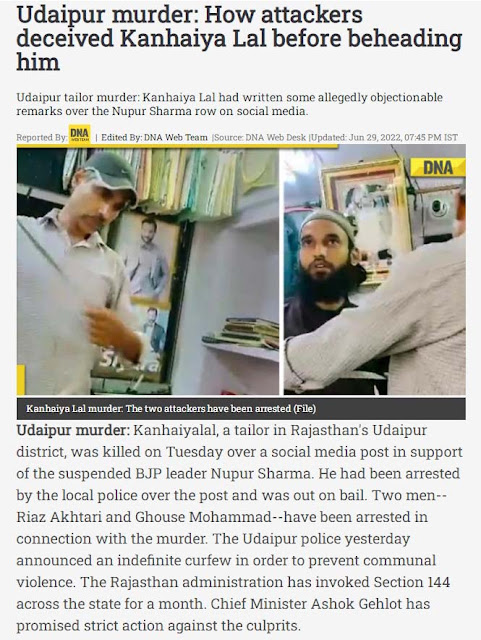
Udaipur tailor murder case: Mohammed Riyaz Attari and Ghous Mohammed

  Religious Atrocity in India. How was Kanhaiya Lal killed? Why was the Udaipur tailor murdered? Kanhaiya Lal had written some allegedly obj...