'I LOVE YOU' is not an offensive phrase, if any body says so I don't believe he/she is right person for Human Rights activities.
I got comments from friends in Myspace....... 'Muahs', ' Mwuahs', 'I love you', 'kisses', 'Hugs' 'you are my heart', and there are more romantic phrases. Hundreds and hundreds in number. If you do not believe you come and see the comments of members in Myspace and in my profile. How many people said it to me! I dont find any wrong in it, Its a mere someone's expression for me in virtual world. When some one says it to me I feel a warmth from unknown, unseen friends, makes me comfortable and cordial with her or him. A stimuli helps run the relation long in virtual world in social networking sites.
In the beginning, when I encountered these words I felt shy I used to delete the comments as soon as possible lest somebody known to me reads. I was so shy, LOL. But very soon I have explored and become familiar and accustom with these words and phrases. Actually, these are vehicle to pass one's emotion to other showing steady friendship, a way of convincing genuineness some mute words. An expression of excitement, warm feelings or convey some bond for somebody and totally these expressions are for virtual world. It has no effect in real world. And I started to post such words and phrases back in return to my friends postings or comments.
A few days ago I had posted ' I Love You' out of emotion. And I had to pay a heavy price. At the bottom of someone's photo in Facebook I wrote 3 words ' I love you' as comment. I can not believe these simple innocent words can pull me in embarrassment and force me feel small and harm. It is not illiterate's world, its from western cultural people living in London ( probably) and she is an online officer of a world Human Rights organisation has caused me grieve and pain.
I am not bringing any allegation against somebody but it is harmful to an organisation who are working for mass. You are playing football in mud your body will be muddy you should know. If you are in Japan, what language you speak does not matter people will speak japanese. In Online you know you will be treated as online people. You are dealing with public you should know you have to face the anger of public. In rain you are drenched , in sun you get heat. Otherwise you stay home locked inside. no one will go to you. Among public you are one of the public no one will woo you as an individual. We are out here to serve the society/nation, we see you as a representative of an organisation among public, whatever we say you we say it to your organisation, not individually you.
' I love you ' is the most used phrases worldwide. if your mind is full of vulgar you will mean it as vulgar, if your mind is sacred you will mean it as sacred. it depends how you see it . Not the people who said it. You are proving what you are.
I am basically a poet and painter, for last 3 years, I am addicted to online, All I do is spreading the news/message from Human Rights. I read online bulletins/ News published by different organizations such as International PEN and its centers, Article19, IFEX, Amnesty international, UN, and other org. working for Freedom of Expression. I republish the important news in my blog ( I maintain a number of blogs) and some times I sum up the news and add my views , sometime I draw cartoons or create a painting. This take a lot time and energy. Its not so much easy and fun. besides every month, I have to pay about one thousand Rupees for broadband connections. It is high price for a poor Indian. ( I did not have any service, trade/ business, as a freelance writer and artist I spent my whole life in misery. I wrote about 100 hundred books which are used by lakhs people every year, this contribution of mine helps promote users life but not mine LOL I dont get royalty, simply they dont pay me). My financial state is very poor, due to this my family has to starve but it never deters me from doing so, I feel pleasure, I know I am rendering a great service to this nation/ world. This makes me happy. And forget all pain.
This activities have become a part of my life. I have about one thousand friends in social networking sites, my favourite is 'Myspace' where everyday I have to post almost one hundred comments or scraps, because I receive scraps from friends. I fear if i keep silent or ignore they will not listen me in my need. I pull traffic from these sites ( Orkut, Facebook and Bebo).
' I love you ' this expression has brought a lot of friends to me and to other users. I dont see any wrong with this word. Say with me ..... I LOVE YOU.
This is a part of a story, some documents and conversations will be added soon keep in touch till I am back
Wednesday, June 23, 2010

Thursday, June 17, 2010
ডিস্ট্রিক্ট কাউন্সিল অফ কালচার, কালাহান্ডি : “অল ইন্ডিয়া পেইন্টিং এগজিবিশান অ্যানড ওয়ার্কশপ”
xxxxxx


 Title : Innocent Victim
------------------------------x-------------------------------
ডিস্ট্রিক্ট কাউন্সিল অফ কালচার, কালাহান্ডি ও ললিত কলা অ্যাকাডেমি, উড়িষ্যা, যৌথভাবে কালাহান্ডি জ়েলার ভবানিপাটনা শহরে, গত ৩সরা মে থেকে ৯ই মে ২০১০, অনুস্থিত করল “অল ইন্ডিয়া পেইন্টিং এগজিবিশান অ্যানড ওয়ার্কশপ”।
 I am flanked by two fellow painters from other states
 I am being awarded at KalaHandi , Odisha,
 A painting I had done inside Bhawani patna Jail being invited to demonstrate the inmates of the jail how to paint
 The painting I had given to Jail authority as gift

I am and another painter being honoured inside jail by jail super and government of Odisha


 Title : Innocent Victim
------------------------------x-------------------------------
ডিস্ট্রিক্ট কাউন্সিল অফ কালচার, কালাহান্ডি ও ললিত কলা অ্যাকাডেমি, উড়িষ্যা, যৌথভাবে কালাহান্ডি জ়েলার ভবানিপাটনা শহরে, গত ৩সরা মে থেকে ৯ই মে ২০১০, অনুস্থিত করল “অল ইন্ডিয়া পেইন্টিং এগজিবিশান অ্যানড ওয়ার্কশপ”।
উল্লেখযোগ্য কর্তাদের মধ্যে ছিলেন আর এস গোপালন (আই এ এস, কালেক্টর ও চেয়ারম্যান ডিস্ট্রিক্ট কাউন্সিল অফ কালচার, কালাহান্ডি), জগন্নাথ মহান্তি, (সাব ডিভিশনাল ম্যাজিস্ট্র্যাট), ললিতকলার চেয়ারম্যান দুর্গাপ্রসাদ দাস, অক্ষয় কুমার পট্টনায়ক (কো-অরডিনেটর) পেইন্টার ও মনোজ রাউত স্থানীয় শিল্পী প্রমুখ। প্রায় শতাধিক শিল্পী – প্রতিবেশি রাজ্যগুলি থেকে – পশ্চিম বংগ, ঝাড়খন্ড, বিহার, দিল্লী ও মূলতঃ উড়িষ্যার শিল্পীরা।
ওয়ার্কশপ চলেছে ৯টা থেকে সন্ধ্যে অবধি ৩,৪,৫,৬,৭ ই মে। প্রতিদিন সন্ধ্যেবেলায় মঞ্চে উড়িষ্যার বিভিন্নপ্রান্তের আদিবাসি গান ও নাচের প্রদর্শনীর ব্যাবস্থা ছিল। অতি চমৎকার সেসব প্রদর্শন। পরিচালনা করেছেন উমেশ চন্দ্র শতপথী তার অপূর্ব সুন্দর গলায়। তিনি ভিমলা কনভেন্ট স্কুলের বর্ষীয়ান শিক্ষক ও স্বনাম ধন্য নাট্যকার। ৭ই মে সন্ধ্যেবেলায় ছিল পুরস্কার বিতরনী অনুষ্ঠান। প্রশাসনের কর্তা ব্যাক্তিরা সামনে থেকে ও ললিত কলার চেয়ারম্যানের হাত দিয়ে।অনেক শিল্পীকে নানা সম্মানে ভুষিত করেছেন। নানা শিল্পীর জীবন ও কর্ম জনসমক্ষে তুলে ধরেন। এই কর্মকান্ডের উল্লেখযোগ্য শিল্পীরা ছিলেন অ্যালবার্ট অশোক কলকাতা, তারকশঙ্কর রাঁচি, উজ্জল ঘোষ হাজারিবাগ, উত্তম মল্লিক জামশেদপুর,পাটনা, ও অনেক উড়িষ্যার শিল্পীরা। উল্লেখ্য এই বিশাল শিল্পযজ্ঞে শ্রেষ্ঠত্বের শিরোপা পেলেন কলকাতার অ্যালবার্ট অশোক। তাকে ‘সত্য শিব সুন্দর’ উপাধিতে ভূষিত করেন।
অ্যালবার্ট অশোক জানান তিনি একটি অ্যাক্রিলিকে ছবি আঁকেন, নাম দেন ‘ইনোসেন্ট ভিক্টিম’। ছবিতে দেখান চাঁদনীরাত, চারিদিকে অন্ধকার, দূরে একটি শুকনো পাতাহীন অস্পস্ট গাছ, অন্ধকারের মধ্যে একটি বলির ছাগল একবারে সামনে ছবির একতৃতীয়াংশ জুড়ে ভেসে উঠছে – কপালে সিঁদুরের টিপ, গলায় ফুলমালা শুন্য দৃষ্টি, করুণ ভাবে তাকিয়ে আছে। সে নিজেকে বাঁচাবার ক্ষমতা হারিয়ে ফেলেছে, অসহায়।
‘ইনোসেন্ট ভিক্টিম’ শুধু বলির ছাগলরাই নয়, সাধারণ মানুষরাও। সাধারন মানুষ অহরহ বলি হচ্ছে ছাগলের মত নানাভাবে, তাদের অসহায় অবস্থা এই সমাজ ও রাস্ট্রের ভাবা উচিত।
উমেশ শতপথি জানান, কালাহান্ডিতে একটা বিশেষ ধর্মীয় অনুষ্ঠানে সমস্ত রাত হাজার হাজার পাঠা বলি হয়। রাস্তায় রক্তনদী বয়ে যায়। প্রশাসনের ও বেসরকারী সেবা প্রতিষ্ঠানগুলি সম্মিলিত প্রচেস্টা করেও এই ছাগল নিধন যজ্ঞ বন্ধ করতে পারেনি। গুরুতর বিষয় ভাবা দরকার।
৫ মে প্রশাসন থেকে অ্যালবার্ট অশোক ও তারকশঙ্করকে স্থানীয় জেলে আমন্ত্রণ করে এক মহোৎ উদ্দেশ্যে নিয়ে গেল, সাথে প্রচার মাধ্যেমের লোকেরা (ই টি ভি)। জেল কর্তৃপক্ষ অপরাধীদের শোধরাবার জন্যে অনেক ব্যাবস্থা নেন, সাংস্কৃতিক কর্মকান্ডের মাধ্যমে অপরাধীদের মন বিশুদ্ধ করতে চান, এছাড়া। জেলে অনেক বন্দি অবসর সময়ে ছবি আঁকেন, ও যারা আঁকাকে বুঝতে চান, শুরু করতে চান তাদের অনুপ্রেরণা ও উদ্ধুদ্ধ করতে অ্যালবার্ট অশোক ও তারকশঙ্করকে বলা হল ছবি এঁকে বন্দিদের কিছু বুঝাতে। একটা দুই আড়াই ক্যানভাসে অ্যালবার্ট অশোক অ্যাক্রিলিকে আঁকলেন ঘরের ভেতর একটা টব খোলা জানলার শিক গলে তার শরীরের অনেকটা অংশ রোদ্দুরের দিকে এগুচ্ছে, তার শরীরে ফুল, কলি ইত্যাদি আর পাঁচটা প্রাকৃতিক গাছের মতো—প্রজাপতি উড়ে এসে তার ফুলে বসছে।
অ্যালবার্ট অশোক বুঝাতে চেয়েছেন বন্দিরা ইচ্ছে করলে জেলের দিন গুলি কাজে লাগিয়ে আবার স্বাভাবিক জীবনে ফিরতে পারেন।
পুরো কর্মকান্ডে জগন্নাথ মহান্তি, (সাব ডিভিশনাল ম্যাজিস্ট্র্যাট), সক্রিয় ভুমিকা আমাদের ঋণী করে রাখে।
সরকারি খরচে কালাহান্ডির বেশ কিছু দর্শণীয় স্থান পরিদর্শন করলাম। খাকসি, জাকুম, করলাপাট স্যাঙ্কচুয়ারি ইত্যাদি---- মনে হল বুভুক্ষু কালাহান্ডি জেগে উঠছে তার আপন ঐতিহ্যে গরবিনী হয়ে।
 I am flanked by two fellow painters from other states
 I am being awarded at KalaHandi , Odisha,
 A painting I had done inside Bhawani patna Jail being invited to demonstrate the inmates of the jail how to paint
 The painting I had given to Jail authority as gift
I am and another painter being honoured inside jail by jail super and government of Odisha
Sunday, May 16, 2010
Level of Indian Poverty:Diet of mud and despair in Indian village
I read an alarming news of poverty on bbc . It is a shame to the political leaders lives nearby. The news as below
-------------------------------------------------------
http://news.bbc.co.uk/2/hi/south_asia/8682558.stm
-------------------------------------------------------
http://news.bbc.co.uk/2/hi/south_asia/8682558.stm
Diet of mud and despair in Indian village
By Chris Morris
BBC News, Ganne, Uttar Pradesh

BBC News, Ganne, Uttar Pradesh
 Children in Ganne have to eat dried mud and silica |
"We live on a day-to-day basis," Suraj says, as the faint sound of hammering echoes across the village. "What we earn is what we spend on our families in a day."
In Ganne, just off the main road about an hour south of the city of Allahabad, this is a simple fact of life.
It is home to members of a poor tribal community, who live in small huts clustered around a series of shallow quarries.
Inside one of the huts sits a little girl called Poonam. She is three years old, and in the early stages of kidney failure.
Like many children in Ganne she has become used to eating bits of dried mud and silica, which she finds in the quarry. Tiny children chew on the mud simply because they are hungry - but it is making them ill.
When reports first emerged of children eating mud here local officials delivered more food and warned the villagers not to speak to outsiders. But Poonam's father, Bhulli, is close to despair.
 |  What can we do? We eat the mud from the quarry when we feel hungry What can we do? We eat the mud from the quarry when we feel hungry  Phulkari Villager |
"What can I say," he shrugs. "We can't afford to eat properly, so how can I afford to buy medicines for her?"
"I am really worried about my daughter, but I don't know what to do next. The poor need the government's help - if we had it, we wouldn't be in such a desperate state."
People like Bhulli and Suraj make their money filling lorries with bits of rock. It takes about eight hours for five men to fill one load. They carry the stones up from the quarry in plastic washing-up bowls balanced on their heads.
One of the women in the village, Phulkari, approaches to tell us about her little boy.
"My son's name is Suraj, and he's started eating mud too," she says. "What can we do? We eat the mud from the quarry when we feel hungry."
"Where do we get the money?" she asks. "We usually eat food only once a day. Last night we went to bed without eating anything at all."
Food protests
The World Bank estimates that one third of all the very poorest people in the world live in India, and stories like those from Ganne have now inspired a national Right To Food campaign.
 |
There have been protest rallies in the heart of Delhi, as the Indian parliament prepares to debate a new Food Security Bill. It will dictate how many people in the country get access to massively subsidised food grain.
There's no doubt that India should be able to afford to feed its people. But the devil is in the detail.
"It'll only cost the government about 1.2% of GDP to universalize a system of giving food for all, cheap food for all," says Kavitha Srivastava, the national coordinator of the Right to Food campaign.
"They can do it, if they have the political will. It's prioritising - where do you want to put the money?"
"We think it should go in building people's nutrition levels. You can't have a country which is weak, which is hungry, which is anaemic. How can you have a nation like this?"
Now the government seems to be prepared to accept a new way of defining poverty, which will increase the number of people below the poverty line by more than 100 million to about 372 million.
| If you simply throw money at this problem...you'll have to throw four times the amount to get the result you want. And the government of India can't afford that. Dr Kaushik Basu Finance ministry economic advisor |
If international poverty standards were used, the number would be much higher still - and some Indian economists believe it should be.
But whichever figure is used, the poverty line feels like a rather fictitious divide because feeding more than a billion people is a massive logistical exercise. Vast quantities of food provided by the state go missing every day because of corruption and theft.
"Food ought to be a right," says Dr Kaushik Basu, the Chief Economic Advisor at India's Ministry of Finance. "And I believe this is a movement in the correct direction."
"But what worries me at times is that we're being too glib and quick about the delivery mechanism."
Official estimates are that right across the country 75% of subsidised grain does not make it to the intended target in villages like Ganne.
"So if you simply throw money at this problem, you'll have to throw four times the amount to get the result you want," says Dr Basu. "And the government of India can't afford that. The budget will go bust."
In other words, the delivery system needs to be reformed as well - and corrupt local officials need to be taken to task. There is a long way to go.
Daunting challenge
Jean Dreze, a highly respected Belgian-born academic who has worked in India for many years, points out that the current debate is only about the most basic levels of food intake.
 There are fair price shops where people can buy subsidised foodgrain |
"For a family of five to have reasonably good nutrition, nothing like meat or fish or any such thing, but just one egg per person per day, one banana, some dhal, some vegetables, a reasonably balanced diet - it would cost more than 200 rupees ($4.4; £3) per family per day," he says.
And that is far more than the amounts being discussed at the moment.
It is a sobering reminder that feeding India is a daunting challenge - the government knows it, and the prime minister says it must be a priority. But the Right to Food Campaign insists they are not doing enough.
The Indian economy continues to grow at impressive speed, and there is no shortage of food in the country. It just isn't reaching the people who need it most, on a consistent basis.
So in Ganne they continue to eat mud. And without finding a solution here in India, the world will come nowhere near the targets it has set itself for reducing global poverty.
Monday, April 12, 2010
A tale of Birds
I have been emotionally charged when I read this story. An Australian friend sent me a few months back


I dont know about animals and birds whether they have emotions like human kind. But tragedy drives me mad.


I dont know about animals and birds whether they have emotions like human kind. But tragedy drives me mad.
Wednesday, March 31, 2010
A National level Art Camp at Dhanbad


A national Art camp organised by Dhanbad based Seven Colours, began on 19 th March ended on 21st March 2010 at Agrasen Bhavan, Hirapur,
Dhanbad. 85 artists, senior and junior from different states joined the Art Camp and painted canvases on their own style and form. The organisers are trying to promote Art among common people in Dhanbad.
In general, interested common people have much curiosity about paintings and painters, such art camp is the opportunity for common viewers to witness how a painter works on his paintings. Every artist has his/her own style and technique to dipict ideas. Viewers can directly interact with artists about art. Art helps society grow with education, art and culture. Besides, for better communication and expression art in form of drawing and painting is indispensable part of our society.
Jharkhand, Dhanbad need such art camp more and more.
A few media document of this art camp given below:


Sahitya Setu and 30th kabi mela

Sahitya Setu a literary Magazine, hosted a 30th annual 'Kabimela' (a big
gathering of poets) on last 14 th march , Sunday, 2010. at Bansberia
Jute Mill, Bandel, Hooghly.
Sahitya setu, a fortnightly literary journal has crossed 43 years of
regular publication. A little magazine survives 43 years with good
reputation and regular basis is a matter of pride.
About 200 hundred poets gathered at the big hall and read their own
poems, discussed on contemporary poetry. A few came from our
neighbouring country Bangladesh.
Sahitya setu also awarded a few new and old poets too.
The editor of this journal is Dr. Jagabandhu Kundu.
contact:
033-26346384
09433503396
sahityasetud@yahoo.com
Below the invitation card:

Tuesday, March 30, 2010
The 28th Agartala Book Fair
The 28th Agartala Book Fair Organised by the Information Cultural Affairs and Tourism (ICAT) Department of Tripura with the cooperation of state publishers, the twelve-day-long fair had been held at the Sishuniketan ( children park) ground of Agartala. It ended on March 11.
Tripura Chief Minister Manik Sarkar inaugurated the fair in the presence of Assam Sahitya Sabha Padma Shri Rong Bong Terang and Vice-Chancellor of Tripura (Central) University, Arunoday Saha.
Book sellers from Kolkata, Delhi, Bangladesh and others had participated in the 163 stalls of book fair. Booklovers consider the fair to be a golden opportunity. Writers and publishers are also very happy about the fair doing good business.
Everyday, there were cultural ceremonies /seminars/ function in the open air stage. Below a document of a cultural activities, click the bengali image to enlarge

I visited Agartala on this occasion, ( reached 28th feb 10 in the morning flight and returned on 12 march in the evening by flight) and on the 6th march I read my poem among audiences with other poets. I enjoyed the Bookfair with prominent writers, publishers in Agartala, Tripura.
 A few writers with me in front of Tripura Government Art College Building
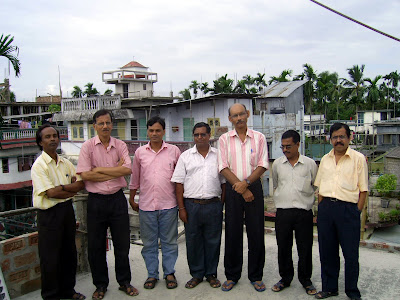
I am with my writers friend at Krishna Nagar, Agartala.
Tripura Chief Minister Manik Sarkar inaugurated the fair in the presence of Assam Sahitya Sabha Padma Shri Rong Bong Terang and Vice-Chancellor of Tripura (Central) University, Arunoday Saha.
Book sellers from Kolkata, Delhi, Bangladesh and others had participated in the 163 stalls of book fair. Booklovers consider the fair to be a golden opportunity. Writers and publishers are also very happy about the fair doing good business.
Everyday, there were cultural ceremonies /seminars/ function in the open air stage. Below a document of a cultural activities, click the bengali image to enlarge

I visited Agartala on this occasion, ( reached 28th feb 10 in the morning flight and returned on 12 march in the evening by flight) and on the 6th march I read my poem among audiences with other poets. I enjoyed the Bookfair with prominent writers, publishers in Agartala, Tripura.
 A few writers with me in front of Tripura Government Art College Building
I am with my writers friend at Krishna Nagar, Agartala.
Wednesday, July 22, 2009
An art review on prasanto basu


I wrote reviews in periodicals/ magazines. On request to write some reviews I used to visit galleries. This review was published in samakal magazine from barasat
Tuesday, July 21, 2009
Reading English Poem

Writing Poem in English was my habit and used to read them in in our poetry reading session at Tamer Lane, Kolkata 700009. A weekly magazine published this incident. The above Picture is a cutting of the news.
In search of painters : An article


This is a cutting of a review on new generation painters. A group of youth held an exhibition at Academy of Fine Art. I wrote the title ' In search of an artis'
Review: Nikhilesh Das


Nikhilesh Das was a prominent and renowned painter. I made a review on him. Darshak literary journal had given me the assignment.

Monday, July 13, 2009

Looking back my works of Literature
I started writing bengali poems after my english poetry book ' Ravishing Youth 300' published. my friends would express their views in jest that I would return in bengali writing like Michael Madhusudan Datta, the legend in Bengal. M M D is my only inspiration I dreamed in my childhood, I wanted to become a rebel poet like him. I ignored nobel Laureate poet Rabindranath Tagore , I dont have explanation why but felt deep to avoid him, and so I did. I loved Nazrul Islam and his songs.. any way
I write in both language Bengali and English, I could not learn Hindi I should have learnt..
all my reviews in periodicals and daily papers were an invasion to correct my wild fancy and construction of poetry.
---------------------------------------------------------------------------------------------


1-----------------------------------------------------------------------
 2
2
 3
3


4 ----------------------------------------------------


5-----------------------------------------------------
I write in both language Bengali and English, I could not learn Hindi I should have learnt..
all my reviews in periodicals and daily papers were an invasion to correct my wild fancy and construction of poetry.
---------------------------------------------------------------------------------------------


1-----------------------------------------------------------------------
 2
2 3
3

4 ----------------------------------------------------


5-----------------------------------------------------

Subscribe to:
Posts (Atom)
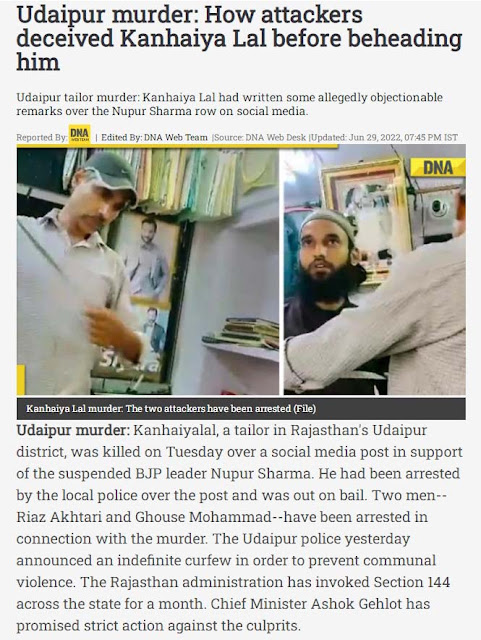
Udaipur tailor murder case: Mohammed Riyaz Attari and Ghous Mohammed
Religious Atrocity in India. How was Kanhaiya Lal killed? Why was the Udaipur tailor murdered? Kanhaiya Lal had written some allegedly obj...
-
 Against War, Terrorism and Corruption: Paintings created by Albert Ashok When Wall street journalist, Daniel Pearl, with Ame...
 -
 Religious Atrocity in India. How was Kanhaiya Lal killed? Why was the Udaipur tailor murdered? Kanhaiya Lal had written some allegedly obj...
 -
 "In this contemporary political scenario, Chaos is my best man. He strikes us with wonder and deception; he is an avenger as ...